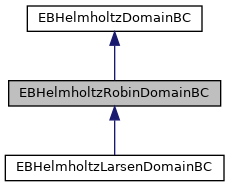
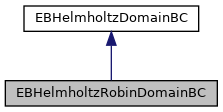
Base class for passing Robin domain boundary conditions into EBHelmholtzOp. More...
#include <CD_EBHelmholtzRobinDomainBC.H>
Public Member Functions | |
| EBHelmholtzRobinDomainBC () | |
| Default constructor. Must subsequently set coefficients. | |
| virtual | ~EBHelmholtzRobinDomainBC () |
| Destructor. | |
| void | setCoefficients (const Real a_A, const Real a_B, const Real a_C) |
| Set constant coefficients. | |
| void | setCoefficients (const std::function< Real(const RealVect &a_pos)> &a_A, const std::function< Real(const RealVect &a_pos)> &a_B, const std::function< Real(const RealVect &a_pos)> &a_C) |
| Set variable coefficients. | |
| virtual void | getFaceFlux (BaseFab< Real > &a_faceFlux, const BaseFab< Real > &a_phi, const BaseFab< Real > &a_Bcoef, const int &a_dir, const Side::LoHiSide &a_side, const DataIndex &a_dit, const bool a_useHomogeneous) const override |
| Get face flux. This is for regular cells. | |
| virtual Real | getFaceFlux (const VolIndex &a_vof, const EBCellFAB &a_phi, const EBFaceFAB &a_Bcoef, const int &a_dir, const Side::LoHiSide &a_side, const DataIndex &a_dit, const bool a_useHomogeneous) const override |
| Get face flux. This is for irregular cells. | |
| Real | getDiagWeight (const int a_dir, const Side::LoHiSide a_side) const override |
| Diagonal-weight multiplier for the domain-face contribution to the relaxation diagonal. | |
 Public Member Functions inherited from EBHelmholtzDomainBC Public Member Functions inherited from EBHelmholtzDomainBC | |
| EBHelmholtzDomainBC () | |
| Constructor. | |
| virtual | ~EBHelmholtzDomainBC () |
| Destructor. | |
| EBHelmholtzDomainBC (const EBHelmholtzDomainBC &a_other)=delete | |
| Disallowed – don't see why you would need it. | |
| EBHelmholtzDomainBC (const EBHelmholtzDomainBC &&a_other)=delete | |
| Disallowed – don't see why you would need it. | |
| EBHelmholtzDomainBC & | operator= (const EBHelmholtzDomainBC &a_other)=delete |
| Disallowed - don't see why you would need it. | |
| EBHelmholtzDomainBC & | operator= (const EBHelmholtzDomainBC &&a_other)=delete |
| Disallowed - don't see why you would need it. | |
| virtual void | define (const Location::Cell a_dataLocation, const EBLevelGrid &a_eblg, const RealVect &a_probLo, const Real a_dx) |
| Define function. | |
Protected Attributes | |
| bool | m_useConstant |
| Use constant for BC. | |
| bool | m_useFunction |
| Use function for BC value. | |
| Real | m_constantA |
| Constant A-coefficient. | |
| Real | m_constantB |
| Constant B-coefficient. | |
| Real | m_constantC |
| Constant C-coefficient. | |
| std::function< Real(const RealVect &a_pos)> | m_functionA |
| Function-based A-coefficient. | |
| std::function< Real(const RealVect &a_pos)> | m_functionB |
| Function-based B-coefficient. | |
| std::function< Real(const RealVect &a_pos)> | m_functionC |
| Function-based C-coefficient. | |
| Protected Attributes inherited from EBHelmholtzDomainBC | |
| Location::Cell | m_dataLocation |
| Data centering. | |
| Real | m_dx |
| Grid resolution. | |
| RealVect | m_probLo |
| Lower-left corner of computational domain. | |
| EBLevelGrid | m_eblg |
| Level grid. | |
Additional Inherited Members | |
| Protected Member Functions inherited from EBHelmholtzDomainBC | |
| RealVect | getBoundaryPosition (const IntVect &a_iv, const int &a_dir, const Side::LoHiSide &a_side) const |
| Returns the cell-centered position at the boundary. | |
| Static Protected Member Functions inherited from EBHelmholtzDomainBC | |
| static void | multiplyByBcoef (BaseFab< Real > &a_flux, const BaseFab< Real > &a_bco, const int a_dir, const Side::LoHiSide a_side) |
| Utility function which multiplies the flux (or actually, dphi/dn) by the B-coefficient. This is used by the implementation classes when they compute the regular flux at the domain edges/faces. | |
| Static Protected Attributes inherited from EBHelmholtzDomainBC | |
| static constexpr int | m_comp = 0 |
| Component that everything is defined for. Always have m_comp = 0. | |
| static constexpr int | m_nComp = 1 |
| Number of components. Always have m_nComp = 1. | |
Detailed Description
Base class for passing Robin domain boundary conditions into EBHelmholtzOp.
Robin bcs are in the form A*phi + B*dphi/dn = C. We impose dphi/dn = (C - A*phi)/B where phi is extrapolated to the EB to first order.
- Note
- The B-coefficient is not the same as in the Helmholtz equation...
- In our notation, n points into the computational domain.
Member Function Documentation
◆ getDiagWeight()
|
overridevirtual |
Diagonal-weight multiplier for the domain-face contribution to the relaxation diagonal.
See EBHelmholtzDomainBC::getDiagWeight for how this is selected. The value here preserves the 1.0 that this BC inherited from the previous (non-pure) base default; it has not been re-derived from the Robin getFaceFlux discretization and should be reviewed against it.
- Parameters
-
[in] a_dir Coordinate direction of the face. [in] a_side High or low side.
- Returns
- Diagonal weight.
Implements EBHelmholtzDomainBC.
◆ getFaceFlux() [1/2]
|
overridevirtual |
Get face flux. This is for regular cells.
- Parameters
-
[in,out] a_faceFlux Face-centered flux. [in] a_phi Cell-centered data [in] a_Bcoef Face-centered B-coefficient [in] a_dir Coordinate direction [in] a_side High or low side [in] a_dit Data index [in] a_useHomogeneous Homogeneous physical BCs or not.
- Note
- a_faceFlux is defined in the first strip of interior cells on the (dir,side) edge of the domain.
Implements EBHelmholtzDomainBC.
◆ getFaceFlux() [2/2]
|
overridevirtual |
Get face flux. This is for irregular cells.
- Parameters
-
[in] a_vof Grid cell [in] a_phi Cell-centered data [in] a_Bcoef Face-centered B-coefficient [in] a_dir Coordinate direction [in] a_side High or low side [in] a_dit Data index [in] a_useHomogeneous Homogeneous physical BCs or not.
- Returns
- Face flux
Implements EBHelmholtzDomainBC.
◆ setCoefficients() [1/2]
| void EBHelmholtzRobinDomainBC::setCoefficients | ( | const Real | a_A, |
| const Real | a_B, | ||
| const Real | a_C | ||
| ) |
Set constant coefficients.
- Parameters
-
[in] a_A Constant A-coefficient [in] a_B Constant B-coefficient [in] a_C Constant C-coefficient
◆ setCoefficients() [2/2]
| void EBHelmholtzRobinDomainBC::setCoefficients | ( | const std::function< Real(const RealVect &a_pos)> & | a_A, |
| const std::function< Real(const RealVect &a_pos)> & | a_B, | ||
| const std::function< Real(const RealVect &a_pos)> & | a_C | ||
| ) |
Set variable coefficients.
- Parameters
-
[in] a_A Spatially dependent A-coefficient [in] a_B Spatially dependent B-coefficient [in] a_C Spatially dependent C-coefficient
The documentation for this class was generated from the following files:
- Source/Elliptic/CD_EBHelmholtzRobinDomainBC.H
- Source/Elliptic/CD_EBHelmholtzRobinDomainBC.cpp