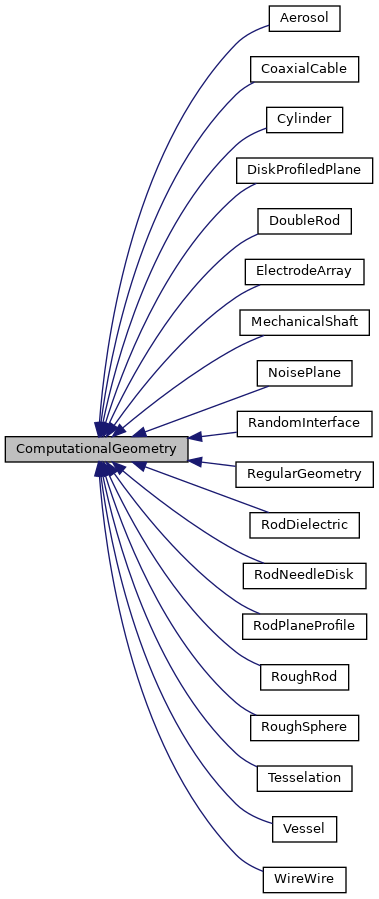
Abstract base class for geometries. More...
#include <CD_ComputationalGeometry.H>
Public Types | |
| using | Vec3 = EBGeometry::Vec3T< Real > |
| Coordinate of a bounding volume of the spatial index. | |
| using | BV = EBGeometry::BoundingVolumes::AABBT< Real > |
| Bounding volume of the spatial index over the boxes of a level. | |
| using | BoxTree = EBGeometry::BVH::PackedBVH< Real, int, K, EBGeometry::BVH::ValueStorage< int > > |
| Spatial index over the boxes of one level. The primitives are the boxes' indices into that level's list, stored by value, and every bounding volume is the box itself in index space, so a query answers with candidates that the exact box test then filters. | |
Public Member Functions | |
| ComputationalGeometry () | |
| Constructor. Sets a blank geometry. | |
| virtual | ~ComputationalGeometry () |
| Destructor. | |
| const Vector< Dielectric > & | getDielectrics () const |
| Get dielectrics. | |
| const Vector< Electrode > & | getElectrodes () const |
| Get electrodes. | |
| Real | getGasPermittivity () const |
| Get the background gas permittivity. | |
| void | useScanShop (const ProblemDomain &a_beginDomain) |
| Calls for ComputationalGeometry to use ScanShop rather than Chombo's default geometry generation tool. | |
| void | useChomboShop () |
| Calls for ComputationalGeometry to use Chombo's geometry generation tool. | |
| void | usePolyhedralShop (const ProblemDomain &a_beginDomain) |
| Generate the geometry with PolyhedralGeometryShop. | |
| void | setDielectrics (const Vector< Dielectric > &a_dielectrics) |
| Set dielectrics. | |
| void | setElectrodes (const Vector< Electrode > &a_electrodes) |
| Set electrodes. | |
| void | setGasPermittivity (const Real a_eps0) |
| Set the background permittivity. | |
| const RefCountedPtr< MultiFluidIndexSpace > & | getMfIndexSpace () const |
| Get the multifluid index space. | |
| const RefCountedPtr< BaseIF > & | getGasImplicitFunction () const |
| Get the implicit function used to generate the gas-phase EBIS. | |
| const RefCountedPtr< BaseIF > & | getSolidImplicitFunction () const |
| Get the implicit function used to generate the solid-phase EBIS. | |
| const RefCountedPtr< BaseIF > & | getImplicitFunction (const phase::which_phase a_phase) const |
| Get implicit function for the specified phase. | |
| virtual void | makeGrids (const ProblemDomain &a_startDomain, const ProblemDomain &a_stopDomain, const RealVect &a_probLo, const Real a_startDx, const Real a_refineAngle, const int a_maxGhostEB, const int a_minBlockSize, const int a_maxBlockSize) |
| Build the grids the index space is generated over. | |
| int | getNumGridLevels () const noexcept |
| Number of levels makeGrids built. | |
| GeometryService::InOut | classify (const Box &a_box, const int a_level, const phase::which_phase a_phase) const |
| Classify a box on a level from the grids makeGrids built. | |
| GeometryService::InOut | classify (const Box &a_box, const ProblemDomain &a_domain, const phase::which_phase a_phase) const |
| Classify a box on any domain at or finer than a level makeGrids built. | |
| int | getStartLevel () const noexcept |
| Level of the start domain. Every level at or below it is whole; the cut tiles begin above it. | |
| int | getLevel (const ProblemDomain &a_domain) const noexcept |
| Level of a domain among the levels makeGrids built. | |
| Vector< Box > | getBoxes (const phase::which_phase a_phase, const int a_level, const GeometryService::InOut a_type) const noexcept |
| Boxes of one classification for a phase on a level. | |
| const Vector< Box > & | getBoxes (const int a_level) const noexcept |
| Every box on a level, both phases' boxes being the same. | |
| const Vector< Box > & | getCutTiles (const int a_level) const noexcept |
| The cut tiles on a level: the boxes of the level that carry cut cells or nest the level above, which is what a simulation grid on the level is made of. On the start level, its boxes irregular in either phase; empty below it. | |
| const Vector< Box > & | getSplitBoxes (const int a_level, Vector< int > &a_reasons) const noexcept |
| The boxes that split in the upward pass on a level, with why: 1 a pair inside the box, 2 a pair reaching into the ring outside it, 3 two surfaces facing each other across the band. | |
| const Vector< GeometryService::InOut > & | getTypes (const phase::which_phase a_phase, const int a_level) const noexcept |
| Classification of every box on a level for a phase, parallel to getBoxes(level). | |
| const ProblemDomain & | getDomain (const int a_level) const noexcept |
| Domain of a level. | |
| Real | getDx (const int a_level) const noexcept |
| Grid spacing of a level. | |
| virtual void | buildGeometries (const ProblemDomain &a_finestDomain, const RealVect &a_probLo, const Real a_finestDx, const int a_nCellMax, const int a_maxGhostEB, const int a_maxCoarsen=-1) |
| Build geometries and the MFIndexSpace. | |
Static Public Attributes | |
| static constexpr int | K = 4 |
| Branching factor of the spatial index over the boxes of a level. | |
Protected Types | |
| enum class | Generator { GeometryShop , ScanShop , PolyhedralShop } |
| Which generator to build the geometry with. More... | |
| enum class | SplitReason { None , Interior , Ring , Medial , DoubleCrossing , Twist } |
| Why a box split: not at all, a pair of cut cells inside the box turning too sharply, such a pair reaching into the ring one cell outside it, a pair whose normals face each other (two surfaces closer than the band), an edge the level above would cross twice, or a cut cell whose interface is twisted into a saddle. More... | |
Protected Member Functions | |
| void | reportGrids () const |
| Report the boxes and tiles of every level to pout. | |
| void | buildImplicitFunctions () |
| Build the composite implicit functions of the two phases from the electrodes and dielectrics. | |
| Vector< Vector< GeometryService::InOut > > & | types (const phase::which_phase a_phase) noexcept |
| The per-level classifications of one phase. | |
| const Vector< Vector< GeometryService::InOut > > & | types (const phase::which_phase a_phase) const noexcept |
| The per-level classifications of one phase. | |
| void | buildStartLevel () |
| Step 0: build and classify the start level. | |
| void | buildFinerLevels (Vector< Vector< int > > &a_firstChild, Vector< Vector< int > > &a_numChildren) |
| Step 1: the upward pass, from the start level to the stop level. | |
| void | classifyBoxes (const Vector< Box > &a_boxes, const int a_level, Vector< GeometryService::InOut > &a_gasTypes, Vector< GeometryService::InOut > &a_solidTypes) const |
| Classify a list of boxes in both phases, the work shared between the ranks. | |
| Vector< int > | splitFlags (const Vector< Box > &a_boxes, const int a_level, const Vector< GeometryService::InOut > &a_gasTypes, const Vector< GeometryService::InOut > &a_solidTypes) const |
| Whether each box must split, the work shared between the ranks. | |
| GeometryService::InOut | classifyBox (const Box &a_box, const int a_level, const phase::which_phase a_phase) const |
| Classify a box of one phase on one level as regular, covered or irregular. | |
| bool | hasTwistedPatch (const Box &a_box, const int a_level, const phase::which_phase a_phase) const |
| Whether any cut cell of the box holds an interface patch that is twisted about its own centre. | |
| SplitReason | exceedsCurvature (const Box &a_box, const int a_level, const phase::which_phase a_phase) const |
| Whether the interface turns by more than m_refineAngle between neighbouring cut cells of a box. | |
| bool | doublyCrossedEdge (const Box &a_box, const int a_level, const phase::which_phase a_phase) const |
| Whether a cell edge of a box is crossed twice by the surface at the spacing of the level above it. | |
| void | makeTiles () |
| Step 2: tile the boxes that are irregular in either phase into one properly nested set per level. | |
| void | classifyTiles (const Vector< Vector< int > > &a_firstChild, const Vector< Vector< int > > &a_numChildren, Vector< Vector< GeometryService::InOut > > &a_gasTileTypes, Vector< Vector< GeometryService::InOut > > &a_solidTileTypes, Vector< Vector< int > > &a_tileHosts) const |
| Step 3: place every tile of every level in the boxes and classify it in both phases. | |
| void | buildBoxTrees () |
| Build the spatial index over the boxes of every level. | |
| std::shared_ptr< BoxTree > | buildTree (const Vector< Box > &a_boxes) const |
| Build one spatial index over a list of boxes. | |
| bool | tagUnresolvedSeams (Vector< IntVectSet > &a_tags) const |
| Tag the cells on the coarse side of a level boundary that the level above it would cross twice. | |
| void | buildTileTrees () |
| Build the spatial index over the cut tiles of every level. | |
| void | buildBoxTree (const int a_level) |
| Build the spatial index over the boxes of one level. | |
| Vector< int > | boxesMeeting (const int a_level, const Box &a_box) const |
| Boxes of a level that intersect a box. | |
| Vector< int > | tilesMeeting (const int a_level, const Box &a_box) const |
| Cut tiles of a level that intersect a box. | |
| int | containingBox (const int a_level, const IntVect &a_cell) const |
| Index of the box of a level that contains a cell, which one box does on a level that is whole. | |
| void | decimateBoxes (const Vector< Vector< GeometryService::InOut > > &a_gasTileTypes, const Vector< Vector< GeometryService::InOut > > &a_solidTileTypes, const Vector< Vector< int > > &a_tileHosts) |
| Step 4: cut every hit box down to what the tiles left of it, and replace the lists on the tiled levels with the result. | |
| void | buildCoarserLevels () |
| Step 5: build the levels coarser than the start level, and push irregularity down onto every whole level. | |
| void | buildGasGeometry (GeometryService *&a_geoserver, const ProblemDomain &a_finestDomain, const RealVect &a_probLo, const Real a_finestDx) |
| Set up the geometry generation tool for the gas phase. | |
| void | buildSolidGeometry (GeometryService *&a_geoserver, const ProblemDomain &a_finestDomain, const RealVect &a_probLo, const Real a_finestDx) |
| Set up the geometry generation tool for the solid phase, i.e. the part inside the dielectrics. | |
Static Protected Member Functions | |
| static BV | boundingVolume (const Box &a_box) noexcept |
| The bounding volume of a box in index space, its cells taken as the unit cubes they are. | |
| static Vector< int > | meeting (const std::shared_ptr< BoxTree > &a_tree, const Vector< Box > &a_boxes, const Box &a_box) |
| The boxes of a list that intersect a box, through the list's spatial index. | |
Protected Attributes | |
| Generator | m_generator |
| Generator selected by the user. | |
| RefCountedPtr< MultiFluidIndexSpace > | m_multifluidIndexSpace |
| Multifluid index spaces. | |
| RefCountedPtr< BaseIF > | m_implicitFunctionGas |
| The gas-phase implicit function (i.e. outside electrodes and dielectrics). | |
| RefCountedPtr< BaseIF > | m_implicitFunctionSolid |
| The solid-phase implicit function (i.e. the inside of the dielectrics). | |
| Vector< Dielectric > | m_dielectrics |
| List of dielectrics. | |
| Vector< Electrode > | m_electrodes |
| List of electrodes. | |
| ProblemDomain | m_scanDomain |
| Grid level where we begin using ScanShop. | |
| RealVect | m_probLo |
| Lower-left corner of the domain. | |
| Real | m_eps0 |
| Background permittivity. | |
| Real | m_refineAngle |
| Angle, in degrees, between neighbouring normals above which an irregular box is split. | |
| bool | m_refineSaddles |
| Whether a box holding a saddle – an interface patch twisted about its own centre – is split. ComputationalGeometry.refine_saddles, optional, off by default; set it true to turn the refinement on. | |
| int | m_maxGhostEB |
| Maximum number of ghost cells that we will ever need. | |
| int | m_startLevel |
| Level of the start domain; every level below it is built whole. | |
| int | m_stopLevel |
| Level of the stop domain, the finest level. | |
| int | m_minBlockSize |
| Tile size, in cells. ComputationalGeometry.min_block_size, 8 when not given. | |
| int | m_maxBlockSize |
| Super-tile size, in cells; the size every box makeGrids makes is split to. ComputationalGeometry.max_block_size, 8 when not given. | |
| bool | m_profile |
| Whether makeGrids reports its levels and its timings to pout. ComputationalGeometry.profile, off by default. | |
| bool | m_verbose |
| Whether every member function announces itself in pout. ComputationalGeometry.verbose, off by default. | |
| Vector< ProblemDomain > | m_domains |
| Domains of the levels makeGrids builds, coarsest first. | |
| Vector< Real > | m_dx |
| Grid spacings of the levels makeGrids builds, coarsest first. | |
| Vector< Vector< Box > > | m_cutTiles |
| Cut-cell tiles per level, common to both phases. | |
| Vector< Vector< Box > > | m_boxes |
| Boxes per level, common to both phases. | |
| Vector< std::shared_ptr< BoxTree > > | m_boxTrees |
| Spatial index over the boxes of every level, one tree per level, holding the boxes' indices into m_boxes. Null on a level with no boxes, and on every level until buildBoxTrees has run. | |
| Vector< std::shared_ptr< BoxTree > > | m_tileTrees |
| Spatial index over the cut tiles of every level, one tree per level, holding the tiles' indices into m_cutTiles. Null on a level with no tiles, and on every level until buildTileTrees has run. | |
| Vector< Vector< int > > | m_splitCounts |
| Per level, the number of boxes that split for each SplitReason, and per level the number of tiles that lie in an irregular box (tagged) versus elsewhere (nesting), for the report. | |
| Vector< Vector< Box > > | m_splitBoxes |
| Per level, the boxes that split in the upward pass, and why (SplitReason as an integer), parallel. | |
| Vector< Vector< int > > | m_splitReasons |
| Per level, the reason each box in m_splitBoxes split. | |
| Vector< Vector< GeometryService::InOut > > | m_gasTypes |
| Gas-phase classification of each box in m_boxes, parallel to it. | |
| Vector< Vector< GeometryService::InOut > > | m_solidTypes |
| Solid-phase classification of each box in m_boxes, parallel to it. | |
Static Protected Attributes | |
| static constexpr Real | s_thresh = 1.E-15 |
| Threshold for Vof computation. | |
| static constexpr bool | s_strictGeometry = true |
| Whether a cut cell whose body will not close stops the run. | |
| static constexpr int | s_treeLeafSize = 8 |
| Boxes per leaf the spatial index over a level's boxes is built with. | |
| static constexpr int | s_maxTilePasses = 8 |
| Most times the tiles are built: the first build, and one more for every pass that finds a cell the level above would cross twice. The run stops if they are all spent with such a cell still unresolved. | |
Detailed Description
Abstract base class for geometries.
This class encapsulates computational geometries in chombo-discharge. If you construct this object as-is, you will get a blank geometry. To include EBs one must set the electrodes and dielectrics. This is not a pure function, so you can set those objects directly from a ComputationalGeometry object. However, in almost all cases one will want to derive from ComputationalGeometry and create a parametrized geometry (that is what $DISCHARGE_HOME/Geometries is for!).
Member Enumeration Documentation
◆ Generator
|
strongprotected |
Which generator to build the geometry with.
Each enumerator names the class that the geometry is generated with.
◆ SplitReason
|
strongprotected |
Why a box split: not at all, a pair of cut cells inside the box turning too sharply, such a pair reaching into the ring one cell outside it, a pair whose normals face each other (two surfaces closer than the band), an edge the level above would cross twice, or a cut cell whose interface is twisted into a saddle.
Only None against anything else decides whether a box splits. Which of the five reasons it is, is recorded for the split report and for the surface file, and is read by nothing that builds the mesh, so it is a diagnostic rather than a part of the generator.
Member Function Documentation
◆ boundingVolume()
|
staticprotectednoexcept |
The bounding volume of a box in index space, its cells taken as the unit cubes they are.
- Parameters
-
[in] a_box The box.
- Returns
- Its bounds, [smallEnd, bigEnd + 1].
◆ boxesMeeting()
|
protected |
Boxes of a level that intersect a box.
- Parameters
-
[in] a_level Level, 0 being the coarsest. [in] a_box Box on that level.
- Returns
- Indices into m_boxes[a_level] of the boxes that intersect it, each once and in increasing order.
◆ buildBoxTree()
|
protected |
Build the spatial index over the boxes of one level.
- Parameters
-
[in] a_level Level, 0 being the coarsest.
◆ buildBoxTrees()
|
protected |
Build the spatial index over the boxes of every level.
One tree per level over that level's boxes, built once the box lists are final. The primitives are the boxes' indices into the level's list and every bounding volume is the box itself, so a query returns the boxes whose bounds meet it and the caller applies the exact test.
◆ buildCoarserLevels()
|
protected |
Step 5: build the levels coarser than the start level, and push irregularity down onto every whole level.
The coarser levels are built as ScanShop builds them, whole and each box classified on its own. On its own a box's classification agrees with the level above only because classifyBox is conservative for a signed-distance function; the second half makes the agreement hold by construction instead. Pseudocode:
for lvl = m_startLevel - 1 down to 0: m_boxes[lvl] = domainSplit(m_domains[lvl], m_maxBlockSize) – no block factor: these levels are not – tiled and the coarsest may be smaller – than a tile classifyBoxes(m_boxes[lvl], lvl) in both phases
for lvl = m_stopLevel - 1 down to 0, per phase: for each box b on lvl + 1 irregular in that phase: the box on lvl containing coarsen(b, 2) is irregular in that phase – exactly one box contains it: every box is a whole super-tile, a whole refinement of one, or a union – of whole tiles, and coarsen(b, 2) is at most half a tile wide on the same lattice.
Runs after decimation: the coarser levels depend on nothing above them, and the push-down needs the final lists of every level above the one it marks.
◆ buildFinerLevels()
|
protected |
Step 1: the upward pass, from the start level to the stop level.
Pseudocode:
for lvl = m_startLevel .. m_stopLevel - 1: for each box on lvl that is regular or covered in both phases: append refine(box, 2) on lvl + 1 with both tags – never a hole beneath these for the boxes on lvl that are irregular in some phase: flags = splitFlags(...): exceedsCurvature, then doublyCrossedEdge, then hasTwistedPatch (if m_refineSaddles), in any phase where the box is irregular for each box with a flag: pieces = domainSplit(refine(box, 2), m_maxBlockSize, m_minBlockSize) classifyBoxes(all pieces, lvl + 1) in both phases, append on lvl + 1 a box without a flag is a leaf: nothing is appended, the region above it is a hole on lvl + 1
The loop always runs to m_stopLevel: once no box splits, the curvature test has nothing to do, but the boxes that are regular or covered in both phases still refine whole onto every remaining level.
The links from each box to its children are handed back for classifyTiles to descend by; they describe the lists as the upward pass leaves them and are stale once decimateBoxes has rewritten a level.
- Parameters
-
[out] a_firstChild Per level and box, the index on the next level of the first child, or -1 for a leaf. [out] a_numChildren Per level and box, the number of children: one for a whole refinement, the number of pieces for a split, zero for a leaf.
◆ buildGasGeometry()
|
protected |
Set up the geometry generation tool for the gas phase.
- Parameters
-
[in,out] a_geoserver Geometry service object which is later used for making build the EB information. [in] a_finestDomain Finest domain which will be used [in] a_probLo Lower-left corner of simulation domain. [in] a_finestDx Finest resolution which will be used.
◆ buildGeometries()
|
virtual |
Build geometries and the MFIndexSpace.
- Parameters
-
[in] a_finestDomain Finest domain [in] a_probLo Lower-left corner [in] a_finestDx Finest grid resolution [in] a_nCellMax Patch size [in] a_maxGhostEB Maximum number of EB ghosts that will be encountered. [in] a_maxCoarsen Max coarsenings to run. If = -1 then coarsen all the way down.
This will build the gas and solid phase domain. The input is the finest-level stuff and you can control the division into boxes as well as the maximum number of coarsenings. The computed domain is (a_probLo, a_probLo + a_box*a_dx)
◆ buildImplicitFunctions()
|
protected |
Build the composite implicit functions of the two phases from the electrodes and dielectrics.
The gas phase is the region outside every object; the solid phase is the region inside the dielectrics and outside the electrodes, and is left null when there are no dielectrics.
◆ buildSolidGeometry()
|
protected |
Set up the geometry generation tool for the solid phase, i.e. the part inside the dielectrics.
- Parameters
-
[in,out] a_geoserver Geometry service object which is later used for making build the EB information. [in] a_finestDomain Finest domain which will be used [in] a_probLo Lower-left corner of simulation domain. [in] a_finestDx Finest resolution which will be used.
◆ buildStartLevel()
|
protected |
Step 0: build and classify the start level.
Pseudocode:
m_boxes[m_startLevel] = domainSplit(m_domains[m_startLevel], m_maxBlockSize, block factor m_minBlockSize) classifyBoxes(m_boxes[m_startLevel], m_startLevel) -> m_gasTypes, m_solidTypes on m_startLevel
◆ buildTileTrees()
|
protected |
Build the spatial index over the cut tiles of every level.
One tree per level over that level's tiles, as buildBoxTrees indexes its boxes. Built once the tiles exist, which is before the boxes are decimated.
◆ buildTree()
|
protected |
Build one spatial index over a list of boxes.
- Parameters
-
[in] a_boxes The boxes.
- Returns
- The tree, holding the boxes' indices into the list, or null if the list is empty.
◆ classify() [1/2]
| GeometryService::InOut ComputationalGeometry::classify | ( | const Box & | a_box, |
| const int | a_level, | ||
| const phase::which_phase | a_phase | ||
| ) | const |
Classify a box on a level from the grids makeGrids built.
Every level is a partition of its domain into boxes, each classified per phase, so the box is regular if every box of the level it meets is regular in the phase, covered if every one is covered, and irregular otherwise – including when it meets both a regular and a covered box, since the surface must then lie between them. This is the answer for a cell or a box anywhere on a stored level; the cut cells themselves are the polyhedral graph's. A level the geometry built no boxes on – everything below it a leaf, so nothing refined that far – is answered by the level below it, coarsening as the domain overload does.
- Parameters
-
[in] a_box Box to classify, on the level's index space. [in] a_level Level, 0 being the coarsest. [in] a_phase Phase.
- Returns
- Regular, covered or irregular.
◆ classify() [2/2]
| GeometryService::InOut ComputationalGeometry::classify | ( | const Box & | a_box, |
| const ProblemDomain & | a_domain, | ||
| const phase::which_phase | a_phase | ||
| ) | const |
Classify a box on any domain at or finer than a level makeGrids built.
On a stored domain this is classify on that level. On a domain finer than every stored level – a simulation level above the stop domain, which the geometry does not describe – the box is coarsened onto the finest stored level and classified there: the coarsening of a box is met by every box the box itself would meet, so a regular or covered answer holds at the finer spacing, and irregular is the conservative answer it always is. The domain must be a refinement by powers of two of a stored one.
- Parameters
-
[in] a_box Box to classify, on a_domain's index space. [in] a_domain Domain the box lives on. [in] a_phase Phase.
- Returns
- Regular, covered or irregular.
◆ classifyBox()
|
protected |
Classify a box of one phase on one level as regular, covered or irregular.
The box is read at the nodes of grow(a_box, m_maxGhostEB) & domain, which are the nodes the polyhedral shop reconstructs the cells of that region from. The rules are applied in this order:
- A phase carrying no implicit function is regular everywhere.
- Irregular as soon as two nodes disagree under isFluid, since some cell of the grown region is then cut in the sense the shop reconstructs cut cells. That is exact whatever the implicit function does away from its zero set, unlike ScanShop's cell-centre test against half a diagonal, which assumes a distance function and is defeated by a smooth union growing faster than one.
- Regular or covered by the verdict every node shares, on the stop level or where the nearest node value exceeds a cell width. Nothing finer describes the stop level, so the rule below would cost tiles and buy nothing there; and a midpoint can only disagree with two agreeing ends if the surface comes within half a cell of the edge, so a cell width is a conservative distance at which to stop reading. Reading the implicit function as a distance here is what the scan-based pruning already does, and a function that is not one must be used with the same caution in both places.
- Irregular where the midpoint of some edge of the node lattice disagrees with its two agreeing ends. The surface then enters and leaves between the nodes, which the level above would see and this one cannot represent, and a cell of it left on the coarse side of a level boundary could not describe its own face there. The midpoint is a node of the level above and is read at that level's spacing, since that is the spacing its snap band is measured against.
- Regular if every node is fluid, covered if every node is solid.
- Parameters
-
[in] a_box Box to classify. [in] a_level Level the box lives on. [in] a_phase Phase whose implicit function is asked.
- Returns
- The classification.
◆ classifyBoxes()
|
protected |
Classify a list of boxes in both phases, the work shared between the ranks.
Rank r classifies every box whose index is r modulo the number of ranks; the answers are combined with one all-reduce, so every rank returns the full lists in the input order.
- Parameters
-
[in] a_boxes Boxes to classify, identical on every rank. [in] a_level Level the boxes live on. [out] a_gasTypes Gas-phase classification of each box. [out] a_solidTypes Solid-phase classification of each box.
◆ classifyTiles()
|
protected |
Step 3: place every tile of every level in the boxes and classify it in both phases.
Pseudocode:
for lvl = m_startLevel + 1 .. m_stopLevel: for each tile t on lvl (every box is a super-tile or a whole refinement of one, so t lies in at most one): if t lies in box i: a_tileHosts[lvl][t] = i per phase: regular or covered box -> t inherits; irregular box -> classifyBox(t, lvl, phase), since the box is conservative and t may be clear of the surface else (above a leaf, a hole): a_tileHosts[lvl][t] = -1 per phase: classifyBox(t, lvl, phase) – a carried tile is generated from the implicit function at its own level, so that is the consistent answer
Nothing is cut here; the hosts are what decimateBoxes reads. The box a tile lies in is found by descending the child links from the start level, where the box containing a point is lattice arithmetic.
- Parameters
-
[in] a_firstChild Child links from buildFinerLevels. [in] a_numChildren Child counts from buildFinerLevels. [out] a_gasTileTypes Gas-phase classification of each tile, indexed [level][tile]. [out] a_solidTileTypes Solid-phase classification of each tile, indexed [level][tile]. [out] a_tileHosts Index of the box each tile lies in, or -1, indexed [level][tile].
◆ containingBox()
|
protected |
Index of the box of a level that contains a cell, which one box does on a level that is whole.
- Parameters
-
[in] a_level Level, at or below the start level. [in] a_cell Cell on that level.
- Returns
- Its box. A cell held by no box or by several stops the run, since the level is then not whole.
◆ decimateBoxes()
|
protected |
Step 4: cut every hit box down to what the tiles left of it, and replace the lists on the tiled levels with the result.
Pseudocode:
for lvl = m_startLevel + 1 .. m_stopLevel: new list = every tile on lvl with its two classifications for each box b on lvl: tiles = { t : a_tileHosts[lvl][t] == b } if tiles is empty: new list += b with its two classifications else if b is irregular in some phase: nothing, the tiles cover it else: new list += (b minus tiles) with b's two classifications – first implementation: TreeIntVectSet in tile coordinates, then createBoxes; – correct and octree-graded, not tight; the packer is replaceable here m_boxes, m_gasTypes, m_solidTypes on lvl = new list
- Parameters
-
[in] a_gasTileTypes Gas-phase classification of each tile, from classifyTiles. [in] a_solidTileTypes Solid-phase classification of each tile, from classifyTiles. [in] a_tileHosts Host of each tile, from classifyTiles.
◆ doublyCrossedEdge()
|
protected |
Whether a cell edge of a box is crossed twice by the surface at the spacing of the level above it.
The three nodes of an edge at the finer spacing are its two ends and its midpoint. Ends that agree under isFluid with a midpoint that disagrees are a surface that enters and leaves through the edge: the edge carries no crossing at this level and one in each half at the next, so a cell holding it cannot describe its own face once the level above describes the other side of it. Such a box is refined until the crossing is resolved, which is what makes the coarse side of a seam representable; a feature the finest level still does not resolve is left to it, since nothing finer describes it.
An end that reads exactly zero is on the surface, and which side of it that end belongs to is not decided at this spacing. The fluid rule breaks the tie toward solid, so an edge reading fluid, solid, zero would read fluid, solid, fluid had the tie gone the other way, which is a pair. Such an end is therefore left open: the ends count as agreeing if any reading of them makes them, and a midpoint that is itself zero decides nothing and is skipped.
- Parameters
-
[in] a_box Box to test. [in] a_level Level the box is on. [in] a_phase Phase whose implicit function is tested.
- Returns
- True if some cell edge of the box is crossed twice at the finer spacing.
◆ exceedsCurvature()
|
protected |
Whether the interface turns by more than m_refineAngle between neighbouring cut cells of a box.
No index space exists at this point; the cut cells are reconstructed from the implicit function on the level, as the polyhedral shop reconstructs them, and the normal of each is that of its interface polygon. That normal depends on the edge roots alone, so it is a property of the zero set: the implicit function's gradient is not used, because inside a body built by CSG the function is not a distance and its gradient carries the kinks and medial shells of the construction. A phase without an implicit function never asks for a split. Pseudocode:
grown = grow(box, 1) & domain node values over grown, once per node; edge crossings bisected once and shared for each cell in grown: if it is cut and closes, n(cell) = polygon normal for each cut cell in the box and each cut neighbour in its 3^D block: angle > m_refineAngle: Interior if the neighbour is in the box, Ring if in the grown ring; normals facing (dot < 0): Medial the first pair inside the box decides; a ring pair decides only if the box has none of its own
Across a sharp edge the angle never shrinks with dx, so edges refine to the stop level. That is intended.
- Parameters
-
[in] a_box Box to test. [in] a_level Level the box lives on. [in] a_phase Phase whose implicit function is asked.
- Returns
- The reason the box must be split, or None if it need not be.
◆ getBoxes() [1/2]
|
noexcept |
Every box on a level, both phases' boxes being the same.
- Parameters
-
[in] a_level Level, 0 being the coarsest.
- Returns
- The boxes.
◆ getBoxes() [2/2]
|
noexcept |
Boxes of one classification for a phase on a level.
- Parameters
-
[in] a_phase Phase. [in] a_level Level, 0 being the coarsest. [in] a_type Regular, covered or irregular.
- Returns
- The boxes.
◆ getCutTiles()
|
noexcept |
The cut tiles on a level: the boxes of the level that carry cut cells or nest the level above, which is what a simulation grid on the level is made of. On the start level, its boxes irregular in either phase; empty below it.
- Parameters
-
[in] a_level Level, 0 being the coarsest.
- Returns
- The cut tiles.
◆ getDielectrics()
| const Vector< Dielectric > & ComputationalGeometry::getDielectrics | ( | ) | const |
Get dielectrics.
- Returns
- Dielectrics (m_dielectrics)
◆ getDomain()
|
noexcept |
Domain of a level.
- Parameters
-
[in] a_level Level, 0 being the coarsest.
- Returns
- The domain.
◆ getDx()
|
noexcept |
Grid spacing of a level.
- Parameters
-
[in] a_level Level, 0 being the coarsest.
- Returns
- The spacing.
◆ getElectrodes()
| const Vector< Electrode > & ComputationalGeometry::getElectrodes | ( | ) | const |
Get electrodes.
- Returns
- Electrodes (m_electrodes)
◆ getGasImplicitFunction()
| const RefCountedPtr< BaseIF > & ComputationalGeometry::getGasImplicitFunction | ( | ) | const |
Get the implicit function used to generate the gas-phase EBIS.
- Returns
- Gas-phase implicit function.
◆ getGasPermittivity()
| Real ComputationalGeometry::getGasPermittivity | ( | ) | const |
Get the background gas permittivity.
- Returns
- Background gas permittivity
◆ getImplicitFunction()
| const RefCountedPtr< BaseIF > & ComputationalGeometry::getImplicitFunction | ( | const phase::which_phase | a_phase | ) | const |
Get implicit function for the specified phase.
- Parameters
-
[in] a_phase Phase identifier.
- Returns
- Implicit function for the requested phase.
◆ getLevel()
|
noexcept |
Level of a domain among the levels makeGrids built.
- Parameters
-
[in] a_domain Domain to look up.
- Returns
- Its level, 0 being the coarsest, or -1 if there is no such level.
◆ getMfIndexSpace()
| const RefCountedPtr< MultiFluidIndexSpace > & ComputationalGeometry::getMfIndexSpace | ( | ) | const |
Get the multifluid index space.
- Returns
- m_multiFluidIndexSpace
◆ getNumGridLevels()
|
noexcept |
Number of levels makeGrids built.
- Returns
- Number of levels, zero before makeGrids has run.
◆ getSolidImplicitFunction()
| const RefCountedPtr< BaseIF > & ComputationalGeometry::getSolidImplicitFunction | ( | ) | const |
Get the implicit function used to generate the solid-phase EBIS.
- Returns
- Solid-phase implicit function.
◆ getSplitBoxes()
|
noexcept |
The boxes that split in the upward pass on a level, with why: 1 a pair inside the box, 2 a pair reaching into the ring outside it, 3 two surfaces facing each other across the band.
- Parameters
-
[in] a_level Level, 0 being the coarsest. [out] a_reasons One reason per box, parallel to the returned boxes.
- Returns
- The boxes.
◆ getStartLevel()
|
noexcept |
Level of the start domain. Every level at or below it is whole; the cut tiles begin above it.
- Returns
- The start level, 0 being the coarsest.
◆ getTypes()
|
noexcept |
Classification of every box on a level for a phase, parallel to getBoxes(level).
- Parameters
-
[in] a_phase Phase. [in] a_level Level, 0 being the coarsest.
- Returns
- One classification per box.
◆ hasTwistedPatch()
|
protected |
Whether any cut cell of the box holds an interface patch that is twisted about its own centre.
Four crossings on the four edges of a cell that run in one direction are coplanar exactly when f00 + f11 equals f01 + f10; the difference is the twist, and the patch through them is then a saddle. A saddle is the one shape whose fluid can fall into more than one piece when the cell is cut for a refinement, which is a cell the polyhedral path cannot carry single valued.
The test is the position of the patch's own saddle point. Outside the cell's square the patch rises or falls monotonically across the cell in at least one direction, and every sublevel set of such a patch is connected on every sub-rectangle – so the cell is safe at every refinement ratio and is left alone. Inside, it is not, and the box is split. Measured in cell widths, the twist a cell sees scales with the spacing while the tilt that opposes it does not, so refining halves the one and leaves the other: the patch the level above holds is the same saddle seen from further away.
A twist at or below 1e-8 counts as none. The crossings are solved to about 1e-10 of the edge, and a flat face aligned with the grid has its four crossings agree to the last bit, which leaves the twist and both slopes as rounding; the saddle's position is then one rounding error divided by another and falls inside the square as often as not. Without the floor, a flat surface is refined as though it were rough.
This is deliberately separate from exceedsCurvature, which cannot answer it: that rule measures how much the surface turns, and a gentle saddle turns very little while still being a saddle. It is also blind to a loop that wraps a cell corner rather than crossing four parallel edges, which carries the same risk with no quad to test; such a cell is left to the unresolved-cells rule at the finest level.
Cells are reconstructed from the implicit function on the level, as exceedsCurvature reconstructs them, so nothing is asked of an index space that does not yet exist. A phase without an implicit function never asks for a split.
- Parameters
-
[in] a_box Box to test. [in] a_level Level the box lives on. [in] a_phase Phase whose implicit function is asked.
- Returns
- True if some cut cell of the box holds a patch whose saddle lies within it.
◆ makeGrids()
|
virtual |
Build the grids the index space is generated over.
Built before any index space exists, from the implicit functions alone. The start domain is built whole, as is every coarser domain down to the coarsest that can still be coarsened by two; above it the levels are factor-two refinements up to and including the stop domain. Levels are indexed from the coarsest domain; getLevel finds the index of a domain. There is one box hierarchy for both phases, built from both implicit functions together, and every box carries one classification per phase. Without any implicit function every level is one regular box. The tile and super-tile sizes are the class's own, ComputationalGeometry.min_block_size and ComputationalGeometry.max_block_size, read in the constructor.
- Parameters
-
[in] a_startDomain Domain the upward pass starts from. [in] a_stopDomain Finest domain built; a factor-two refinement of a_startDomain some number of times. [in] a_probLo Lower-left corner of the domain. [in] a_startDx Grid spacing on a_startDomain. [in] a_refineAngle Angle, in degrees, between neighbouring normals above which a box is split. [in] a_maxGhostEB Ghost cells a box is grown by when it is classified. At most half the tile size. [in] a_minBlockSize Tile the grids are built with, from AmrMesh.eb_min_block_size. [in] a_maxBlockSize Super-tile the boxes are cut to, a whole number of a_minBlockSize, from AmrMesh.eb_max_block_size.
◆ makeTiles()
|
protected |
Step 2: tile the boxes that are irregular in either phase into one properly nested set per level.
Pseudocode:
for lvl = m_startLevel + 1 .. m_stopLevel: tags[lvl - 1] = every box on lvl irregular in some phase, coarsened by two – TiledMeshRefine takes tags on the level below the one it tiles TiledMeshRefine(m_domains[m_startLevel], ratio 2, m_minBlockSize, m_maxBlockSize).regrid(tiles, tags) m_cutTiles[lvl] = tiles[lvl - m_startLevel] for lvl > m_startLevel; the start level and below are whole and are not tiled
Every box is a super-tile already, so the tags are exact in tile units. The nesting buffer is one tile per level, which is at least m_maxGhostEB when m_minBlockSize >= 2 * m_maxGhostEB. No collar is added: a simulation ghost cell that reaches past the tiles into a hole is the index space's to fill, not carried here.
◆ meeting()
|
staticprotected |
The boxes of a list that intersect a box, through the list's spatial index.
- Parameters
-
[in] a_tree Index over the list, which may be null. [in] a_boxes The list. [in] a_box Box to intersect with.
- Returns
- Indices into the list, each once and in increasing index order. Empty if the tree is null.
◆ setDielectrics()
| void ComputationalGeometry::setDielectrics | ( | const Vector< Dielectric > & | a_dielectrics | ) |
Set dielectrics.
- Parameters
-
[in] a_dielectrics Dielectris
◆ setElectrodes()
| void ComputationalGeometry::setElectrodes | ( | const Vector< Electrode > & | a_electrodes | ) |
Set electrodes.
- Parameters
-
[in] a_electrodes Electrodes
◆ setGasPermittivity()
| void ComputationalGeometry::setGasPermittivity | ( | const Real | a_eps0 | ) |
Set the background permittivity.
- Parameters
-
[in] a_eps0 Gas permittivity
◆ splitFlags()
|
protected |
Whether each box must split, the work shared between the ranks.
Same distribution as classifyBoxes. A box splits if exceedsCurvature holds in any phase in which the box is irregular; a box irregular in neither phase never splits.
- Parameters
-
[in] a_boxes Boxes to test, identical on every rank. [in] a_level Level the boxes live on. [in] a_gasTypes Gas-phase classification of each box. [in] a_solidTypes Solid-phase classification of each box.
- Returns
- One flag per box, parallel to a_boxes.
◆ tagUnresolvedSeams()
|
protected |
Tag the cells on the coarse side of a level boundary that the level above it would cross twice.
A cell whose edge carries no crossing while each of its halves carries one describes a surface that enters and leaves through that edge. Nothing is wrong with it until the level above describes the other side of that face: the coarse chord then has no crossing to match the two the children have, and the two descriptions cannot be reconciled. Such a cell is tagged so that the level above covers it too.
Only the cells on the coarse side of a level boundary are examined – a cell whose neighbours are all at its own level takes its chords from the same nodes they do, and a cell the level above already covers is not on the coarse side of anything. That is a shell around the tiled region rather than its volume, so the test is cheap however deep the levels go.
Face neighbours are the whole test, even though the four cells meeting along a doubly crossed edge can include one that meets the refined region along that edge alone. Of the other three, the two sharing a face with the refined one carry the same edge and are tagged on this pass, and once they are refined the fourth has a refined face neighbour and is taken on the next, which is what the repeated passes are for.
- Parameters
-
[in,out] a_tags Tags, in the tiler's levels; cells are added to them.
- Returns
- True if any cell was tagged, so that the tiles must be built again.
◆ tilesMeeting()
|
protected |
Cut tiles of a level that intersect a box.
- Parameters
-
[in] a_level Level, above the start level. [in] a_box Box on that level.
- Returns
- Indices into m_cutTiles[a_level] of the tiles that intersect it, each once and in increasing order.
◆ types() [1/2]
|
protectednoexcept |
The per-level classifications of one phase.
- Parameters
-
[in] a_phase Phase.
- Returns
- m_gasTypes or m_solidTypes.
◆ types() [2/2]
|
protectednoexcept |
The per-level classifications of one phase.
- Parameters
-
[in] a_phase Phase.
- Returns
- m_gasTypes or m_solidTypes.
◆ usePolyhedralShop()
| void ComputationalGeometry::usePolyhedralShop | ( | const ProblemDomain & | a_beginDomain | ) |
Generate the geometry with PolyhedralGeometryShop.
Same topology as the chombo-discharge generator, but the moments are exact integrals of an explicitly reconstructed surface rather than quadratures of the implicit function.
- Parameters
-
[in] a_beginDomain Level on which to initiate the load balancing sequence
◆ useScanShop()
| void ComputationalGeometry::useScanShop | ( | const ProblemDomain & | a_beginDomain | ) |
Calls for ComputationalGeometry to use ScanShop rather than Chombo's default geometry generation tool.
- Parameters
-
[in] a_beginDomain Coarse domain where ScanShop begins the load balancing recursion process.
Member Data Documentation
◆ m_refineSaddles
|
protected |
Whether a box holding a saddle – an interface patch twisted about its own centre – is split. ComputationalGeometry.refine_saddles, optional, off by default; set it true to turn the refinement on.
Splitting such a box removes the cell that would otherwise be unable to refine single valued, and it only reaches a saddle that has refinement left to give: one already at the stop level stays, and is the unresolved-cells rule's to deal with. It is off by default because that rule is to collapse such a cell's pieces into one body without losing conservation (PolyhedralGeometryShop::UnresolvedAction::Collapse, not yet wired), which makes a saddle something to repair rather than something to refine away; switching it on buys centroids that need no repair, at the price of more cells.
◆ s_strictGeometry
|
staticconstexprprotected |
Whether a cut cell whose body will not close stops the run.
Loud by choice while the polyhedral generator is being developed: a cell it cannot close is an edge case worth seeing rather than one worth approximating around. No geometry tested has produced one. Not exposed as an option, so that turning it off is a deliberate edit rather than something an input file can do by accident.
The documentation for this class was generated from the following files:
- Source/Geometry/CD_ComputationalGeometry.H
- Source/Geometry/CD_ComputationalGeometry.cpp