Electrode boundary conditions on the EB faces for PetscHelmholtzOp, taken from ElectrostaticEbBc. More...
#include <CD_PetscHelmholtzElectrostaticEBBC.H>
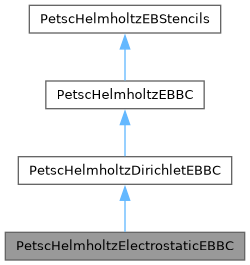
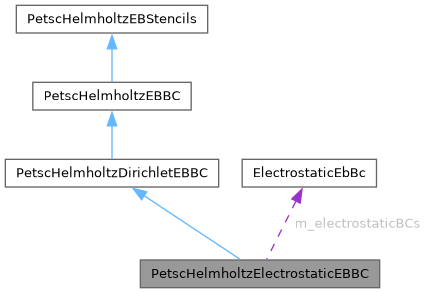
Public Member Functions | |
| PetscHelmholtzElectrostaticEBBC ()=delete | |
| Disallowed default constructor. | |
| PetscHelmholtzElectrostaticEBBC (const ElectrostaticEbBc &a_electrostaticBCs) noexcept | |
| Full constructor. Must subsequently set the order and the weight, and call define. | |
| virtual | ~PetscHelmholtzElectrostaticEBBC () noexcept |
| Destructor. | |
| virtual Real | getBoundaryData (const int a_phase, const int a_level, const DataIndex &a_din, const VolIndex &a_vof) const noexcept override |
| Get the boundary data, i.e. the potential of the closest electrode. | |
| Public Member Functions inherited from PetscHelmholtzDirichletEBBC | |
| PetscHelmholtzDirichletEBBC () noexcept | |
| Default constructor. Must subsequently set the value, the order and the weight, and call define. | |
| virtual | ~PetscHelmholtzDirichletEBBC () noexcept |
| Destructor. | |
| virtual void | setValue (const Real a_value) noexcept |
| Set a constant value on the EB. | |
| virtual void | setValue (const std::function< Real(const RealVect &a_pos)> &a_value) noexcept |
| Set a spatially varying value on the EB. | |
| virtual void | getEBFluxStencil (Real &a_boundaryWeight, PetscStencil &a_stencil, const int a_phase, const int a_level, const DataIndex &a_din, const VolIndex &a_vof) const noexcept override |
| Get the flux through the EB face of a cut cell, without the b-coefficient and the face area. | |
| Public Member Functions inherited from PetscHelmholtzEBBC | |
| PetscHelmholtzEBBC () noexcept | |
| Default constructor. Must subsequently set the order and the weight, and call define. | |
| virtual | ~PetscHelmholtzEBBC () noexcept |
| Destructor. | |
| Public Member Functions inherited from PetscHelmholtzEBStencils | |
| PetscHelmholtzEBStencils () noexcept | |
| Default constructor. Must subsequently set the order and the weight, and call define. | |
| virtual | ~PetscHelmholtzEBStencils () noexcept |
| Destructor. | |
| PetscHelmholtzEBStencils (const PetscHelmholtzEBStencils &a_other)=delete | |
| Disallowed copy constructor. | |
| PetscHelmholtzEBStencils (const PetscHelmholtzEBStencils &&a_other)=delete | |
| Disallowed move constructor. | |
| PetscHelmholtzEBStencils & | operator= (const PetscHelmholtzEBStencils &a_other)=delete |
| Disallowed copy assignment operator. | |
| PetscHelmholtzEBStencils & | operator= (const PetscHelmholtzEBStencils &&a_other)=delete |
| Disallowed move assignment operator. | |
| virtual long long | getNumCellsWithoutStencil () const noexcept |
| Get the number of cut cells, summed over phases, levels and ranks, that have an EB face but no stencil. | |
| virtual void | setOrder (const int a_order) noexcept |
| Set the order of the stencils. | |
| virtual void | setWeight (const int a_weight) noexcept |
| Set the least-squares weighting. | |
| virtual void | clear () noexcept |
| Release the stored stencils, the grids and the interpolators, so that the object can be defined again, e.g. after a regrid. | |
| virtual void | define (const RefCountedPtr< PetscGrid > &a_petscGrid, const Vector< MFMultigridInterpolator > &a_interpolators, const RealVect &a_probLo, const Vector< Real > &a_dx) noexcept |
| Define over the AMR hierarchy, and compute the one-sided normal derivative stencils of every cut cell. | |
Protected Member Functions | |
| virtual Real | getElectrodePotential (const RealVect &a_pos) const noexcept |
| Get the potential of the electrode closest to a position. | |
| Protected Member Functions inherited from PetscHelmholtzEBStencils | |
| virtual void | getNormalDerivativeStencil (Real &a_boundaryWeight, PetscStencil &a_stencil, const int a_phase, const int a_level, const DataIndex &a_din, const VolIndex &a_vof) const noexcept |
| Get the stored one-sided normal derivative at the EB face of a cut cell. | |
| virtual void | computeNormalDerivativeStencil (Real &a_boundaryWeight, PetscStencil &a_stencil, const int a_phase, const int a_level, const DataIndex &a_din, const VolIndex &a_vof) const noexcept |
| Compute the one-sided normal derivative at the EB face of a cut cell. | |
| virtual bool | getLeastSquaresStencil (Real &a_boundaryWeight, PetscStencil &a_stencil, const int a_phase, const int a_level, const DataIndex &a_din, const VolIndex &a_vof, const VofUtils::Neighborhood a_neighborhood, const int a_order) const noexcept |
| Try to compute the one-sided normal derivative at the EB face of a cut cell, for one neighbourhood and one order. | |
| virtual RealVect | getBoundaryPosition (const int a_phase, const int a_level, const DataIndex &a_din, const VolIndex &a_vof) const noexcept |
| Get the physical position of the centroid of the EB face of a cut cell. | |
Protected Attributes | |
| ElectrostaticEbBc | m_electrostaticBCs |
| Electrode boundary conditions. | |
| Protected Attributes inherited from PetscHelmholtzDirichletEBBC | |
| bool | m_useConstant |
| Use the constant value or not. | |
| bool | m_useFunction |
| Use the spatially varying value or not. | |
| Real | m_constantValue |
| Constant value on the EB. | |
| std::function< Real(const RealVect &a_pos)> | m_functionValue |
| Spatially varying value on the EB. | |
| Protected Attributes inherited from PetscHelmholtzEBStencils | |
| bool | m_isDefined |
| Is defined or not. | |
| long long | m_numCellsWithoutStencil |
| Number of cut cells, summed over phases, levels and ranks, that have an EB face but no stencil. | |
| bool | m_verbose |
| Verbose output or not. | |
| int | m_order |
| Highest order of the stencils, or -1 if not set. | |
| int | m_weight |
| Least-squares weighting, or -1 if not set. | |
| RefCountedPtr< PetscGrid > | m_petscGrid |
| PETSc grid. | |
| Vector< MFMultigridInterpolator > | m_interpolators |
| Coarse-fine ghost cell interpolators of both phases, on each level. | |
| RealVect | m_probLo |
| Lower-left corner of the computational domain. | |
| Vector< Real > | m_dx |
| Grid resolution on each level. | |
| Vector< RefCountedPtr< LayoutData< BaseIVFAB< PetscStencil > > > > | m_derivStencils [2] |
| The stencils of the one-sided normal derivatives, over PETSc rows. | |
| Vector< RefCountedPtr< LayoutData< BaseIVFAB< Real > > > > | m_derivWeights [2] |
| The weights w_B of the boundary value in the one-sided normal derivatives. | |
Detailed Description
Electrode boundary conditions on the EB faces for PetscHelmholtzOp, taken from ElectrostaticEbBc.
This is a Dirichlet condition whose value on an EB face is the potential of the closest electrode, as in MFHelmholtzElectrostaticEBBC. The electrode potentials capture the time by reference, so time-dependent potentials enter through the right-hand side.
Constructor & Destructor Documentation
◆ PetscHelmholtzElectrostaticEBBC()
|
noexcept |
Full constructor. Must subsequently set the order and the weight, and call define.
- Parameters
-
[in] a_electrostaticBCs Electrode boundary conditions
Member Function Documentation
◆ getBoundaryData()
|
overridevirtualnoexcept |
Get the boundary data, i.e. the potential of the closest electrode.
- Parameters
-
[in] a_phase Phase [in] a_level Grid level [in] a_din Grid index on the level [in] a_vof Cut cell
- Returns
- The potential of the closest electrode, at the EB face centroid.
Reimplemented from PetscHelmholtzDirichletEBBC.
◆ getElectrodePotential()
|
protectedvirtualnoexcept |
Get the potential of the electrode closest to a position.
- Parameters
-
[in] a_pos Position
- Returns
- The potential of the closest electrode.
The documentation for this class was generated from the following files:
- Source/Electrostatics/CD_PetscHelmholtzElectrostaticEBBC.H
- Source/Electrostatics/CD_PetscHelmholtzElectrostaticEBBC.cpp
Generated by
 1.15.0