Declaration of the cell topology and polygon geometry the polyhedral cut cells are built from. More...
#include <BaseFab.H>#include <BaseIF.H>#include <Box.H>#include <IntVect.H>#include <RealVect.H>#include <CD_CutCellSurface.H>#include <CD_NamespaceHeader.H>#include <CD_NamespaceFooter.H>#include <CD_PolyhedralEBUtilsImplem.H>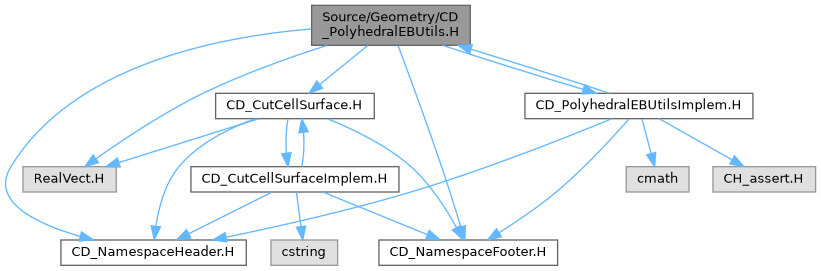
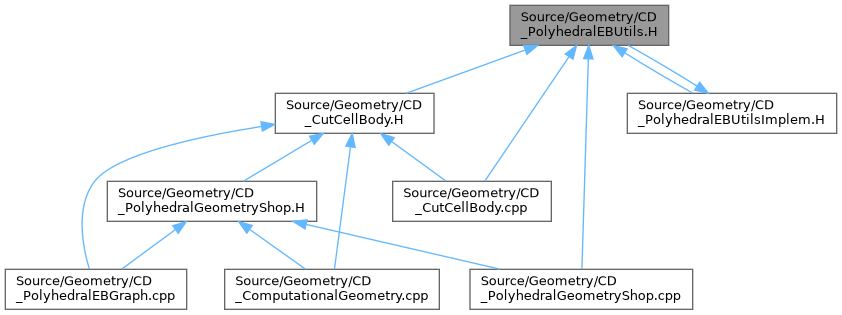
Go to the source code of this file.
Namespaces | |
| namespace | PolyhedralEB::detail |
| Cell topology and polygon geometry the cut cell classes are assembled from. | |
Functions | |
| bool | PolyhedralEB::isFluid (const Real a_value) noexcept |
| Which side of the interface a value lies on. | |
| int | PolyhedralEB::detail::edgeDirection (const int a_edge) noexcept |
| Direction a cell edge runs along. | |
| void | PolyhedralEB::detail::edgeOrigin (const int a_edge, int a_offset[SpaceDim]) noexcept |
| Corner offsets of a cell edge's low end. | |
| void | PolyhedralEB::detail::edgeCorners (const int a_edge, int &a_lo, int &a_hi) noexcept |
| The corners a cell edge joins, low end first. | |
| RealVect | PolyhedralEB::detail::cornerPosition (const int a_corner) noexcept |
| Position of a cell corner in the cell's own frame. | |
| void | PolyhedralEB::detail::faceCorners (const int a_dir, const int a_side, int a_corner[1<<(SpaceDim - 1)]) noexcept |
| The corners of a cell face, in circuit order around the face. | |
| int | PolyhedralEB::detail::edgeIndex (const int a_dir, const int a_offset[SpaceDim]) noexcept |
| Index of the edge running along a_dir whose low corner has the given offsets. | |
| RealVect | PolyhedralEB::detail::crossingPosition (const CutCellSurface &a_surface, const int a_edge, const Real a_tolerance) noexcept |
| Position of an edge crossing in the cell's own frame. | |
| void | PolyhedralEB::detail::faceEdges (const int a_dir, const int a_side, int a_edge[4]) noexcept |
| The edges of a cell face, edge i joining face corners i and i+1. | |
| void | PolyhedralEB::detail::polygonMoments (const RealVect *a_vertex, const int a_num, Real &a_area, RealVect &a_vector, RealVect &a_centroid) noexcept |
| Area vector, area and centroid of a planar polygon given in circuit order. | |
| int | PolyhedralEB::detail::facePairs (const int a_dir, const int a_side, const CutCellSurface &a_surface, int a_pair[2][2]) noexcept |
| The chords on a cell face, each an unordered pair of edge indices. | |
| int | PolyhedralEB::detail::crossingLoops (const CutCellSurface &a_surface, int a_loop[CutCellSurface::s_numEdges], int a_start[CutCellSurface::s_numEdges+1]) noexcept |
| Order the crossings into closed loops, or fail if they do not form clean cycles. | |
| bool | PolyhedralEB::detail::sameVertex (const RealVect &a_a, const RealVect &a_b) noexcept |
| Whether two positions are the same vertex. | |
| bool | PolyhedralEB::detail::sameToRoundOff (const RealVect &a_a, const RealVect &a_b) noexcept |
| Whether two vertices differ only by round-off. | |
| bool | PolyhedralEB::detail::withinInEveryDirection (const RealVect &a_a, const RealVect &a_b, const Real a_margin) noexcept |
| Whether two positions differ by no more than a margin in any coordinate. | |
| RealVect | PolyhedralEB::detail::crossing (const RealVect &a_a, const RealVect &a_b, const int a_dir) noexcept |
| Where the segment between two vertices crosses the plane x[a_dir] = 0, the same to the bit whichever way round the segment is given. | |
| bool | PolyhedralEB::isDust (const PolyhedralEB::CutCellBody &a_body) noexcept |
| Whether a cut body holds nothing at all and is therefore a regular cell. | |
| void | PolyhedralEB::fillNodeValues (BaseFab< Real > &a_nodeValues, const BaseIF &a_function, const Box &a_region, const RealVect &a_probLo, const Real &a_dx) |
| Evaluate the implicit function at every node of a region. | |
| void | PolyhedralEB::defineIntercepts (BaseFab< Real > a_intercept[SpaceDim], const Box &a_region) |
| Size the edge-crossing cache for a region and mark every edge as not yet bisected. | |
| Real | PolyhedralEB::edgeCrossing (const BaseIF &a_function, BaseFab< Real > a_intercept[SpaceDim], const IntVect &a_cell, const int a_edge, const Real a_lo, const Real a_hi, const RealVect &a_probLo, const Real &a_dx) |
| Find where the implicit function changes sign along a cell edge. | |
| void | PolyhedralEB::fillCorners (PolyhedralEB::CutCellSurface &a_surface, const BaseFab< Real > &a_nodeValues, const IntVect &a_cell) |
| Read one cell's corner values off the node values. | |
| void | PolyhedralEB::buildSurface (BaseFab< Real > a_intercept[SpaceDim], PolyhedralEB::CutCellSurface &a_surface, const BaseIF &a_function, const BaseFab< Real > &a_nodeValues, const IntVect &a_cell, const RealVect &a_probLo, const Real &a_dx) |
| Gather the corner values and edge crossings one cell's surface is built from. | |
| void | PolyhedralEB::decideFaces (PolyhedralEB::CutCellSurface &a_surface, const BaseIF &a_function, const IntVect &a_cell, const RealVect &a_probLo, const Real a_dx) noexcept |
| Decide, for every face of a cell whose corners alternate in sign, whether its fluid corners or its solid ones meet across it. | |
| Real | PolyhedralEB::edgeRoot (const BaseIF &a_function, const IntVect &a_edgeIV, const int a_dir, const Real a_loValue, const Real a_hiValue, const RealVect &a_probLo, const Real a_dx) noexcept |
| Bisect one cell edge for the crossing on it. | |
| Real | PolyhedralEB::snappedValue (const BaseIF &a_function, const RealVect &a_point, const Real a_dx) noexcept |
| Read the implicit function at a point, with a value within s_snapTolerance of a cell width of zero read as exactly zero, and a zero that is a tangency read from beside the point instead. | |
| Real | PolyhedralEB::resolveTangency (const BaseIF &a_function, const RealVect &a_point, const Real a_dx) noexcept |
| Read the implicit function beside a point where it is zero, when no surface passes through the point. | |
Variables | |
| constexpr int | PolyhedralEB::detail::s_transverse [3][2] = {{1, 2}, {0, 2}, {0, 1}} |
| The two directions transverse to each coordinate direction, in increasing order. | |
| constexpr Real | PolyhedralEB::detail::s_weldTolerance = 1.0E-10 |
| Distance within which two vertices are taken to be the same one. | |
| constexpr Real | PolyhedralEB::detail::s_roundOffTolerance = 1.0E-13 |
| Distance below which two vertices of a body cut from another are one, since they then differ only by the round-off of the arithmetic that placed them. Far below the weld tolerance, so fluid thinner than the weld keeps its vertices, and far below the tolerance to which a cut reproduces its parent's moments. | |
| constexpr Real | PolyhedralEB::s_snapTolerance = 1.0E-12 |
| Fraction of a cell width within which an implicit-function value is read as exactly zero. | |
| constexpr Real | PolyhedralEB::s_rootSnap = 1.0E-4 |
| Distance along an edge, from an endpoint that is exactly zero, within which a root is put on it. | |
| constexpr Real | PolyhedralEB::s_probeSpacing = 1.0E-6 |
| Fraction of a cell width the implicit function is read at either side of a point, to tell a surface through the point from a zero no surface passes through. | |
Detailed Description
Declaration of the cell topology and polygon geometry the polyhedral cut cells are built from.
Function Documentation
◆ buildSurface()
| void PolyhedralEB::buildSurface | ( | BaseFab< Real > | a_intercept[SpaceDim], |
| PolyhedralEB::CutCellSurface & | a_surface, | ||
| const BaseIF & | a_function, | ||
| const BaseFab< Real > & | a_nodeValues, | ||
| const IntVect & | a_cell, | ||
| const RealVect & | a_probLo, | ||
| const Real & | a_dx ) |
Gather the corner values and edge crossings one cell's surface is built from.
The corners come from the shared node values and every edge whose ends disagree gets its crossing through the shared cache, so every caller that reconstructs a cell – the graph, the surface pass and the grid builder's curvature test – builds the same cell.
- Parameters
-
[in,out] a_intercept Edge-centred crossing cache [out] a_surface The values the cell's body is reconstructed from [in] a_function Implicit function [in] a_nodeValues Node-centred implicit function values [in] a_cell The cell [in] a_probLo Lower-left corner of computational domain [in] a_dx Grid resolution
◆ decideFaces()
|
noexcept |
Decide, for every face of a cell whose corners alternate in sign, whether its fluid corners or its solid ones meet across it.
Four alternating corners admit both readings, and the bilinear interpolant of the corners picks the one its saddle falls on, which for a feature thinner than the face is the wrong one: the large values at two corners outweigh the small ones of a thin plate at the other two, and the chords pierce the plate. The implicit function at the centre of the face is read instead, with the value snap of a grid twice as fine, so that it is the very node a finer level holds there. Every cell sharing the face reads the same point. A centre that reads exactly zero falls back to the bilinear saddle. In two dimensions the face is the cell itself.
- Parameters
-
[in,out] a_surface Surface whose corners are filled; its face decisions are set. [in] a_function Implicit function. [in] a_cell The cell. [in] a_probLo Lower-left corner of the domain. [in] a_dx Grid spacing.
◆ defineIntercepts()
| void PolyhedralEB::defineIntercepts | ( | BaseFab< Real > | a_intercept[SpaceDim], |
| const Box & | a_region ) |
Size the edge-crossing cache for a region and mark every edge as not yet bisected.
One fab per direction, over the edges of the region's cells, addressed by the node at the low end of the edge as edgeCrossing addresses them.
- Parameters
-
[out] a_intercept Edge-centred cache, one fab per direction [in] a_region Cell-centred region whose edges are wanted
◆ edgeCrossing()
| Real PolyhedralEB::edgeCrossing | ( | const BaseIF & | a_function, |
| BaseFab< Real > | a_intercept[SpaceDim], | ||
| const IntVect & | a_cell, | ||
| const int | a_edge, | ||
| const Real | a_lo, | ||
| const Real | a_hi, | ||
| const RealVect & | a_probLo, | ||
| const Real & | a_dx ) |
Find where the implicit function changes sign along a cell edge.
Bisection between the two endpoints, looked up in a cache first. Every cut edge is reached from both of its adjoining faces and from each neighbouring cell, always with the same endpoints, so the root is found once and reused. That is what makes two cells agree on a shared aperture bit for bit.
- Parameters
-
[in] a_function Implicit function [in,out] a_intercept Edge-centred cache, one component per direction [in] a_cell Cell the edge is being read from [in] a_edge Edge index within the cell [in] a_lo Implicit function at the edge's low corner [in] a_hi Implicit function at the edge's high corner [in] a_probLo Lower-left corner of computational domain [in] a_dx Grid resolution
- Returns
- Position along the edge, parameterised from its low corner.
◆ edgeRoot()
|
noexcept |
Bisect one cell edge for the crossing on it.
An endpoint at exactly zero is not taken to be the crossing: the function may be zero along a stretch of the edge (a face of the geometry lying in the edge's plane), and the crossing is where it leaves that stretch. The bisection walks through zeros, which the fluid predicate reads as solid, and a root that lands within s_snapTolerance of an endpoint that is exactly zero is put exactly on it.
- Parameters
-
[in] a_function Implicit function. [in] a_edgeIV Node at the low end of the edge. [in] a_dir Direction the edge runs in. [in] a_loValue Implicit function at the low end. [in] a_hiValue Implicit function at the high end. [in] a_probLo Lower-left corner of the domain. [in] a_dx Grid spacing.
- Returns
- Position along the edge, in [0,1].
◆ fillCorners()
| void PolyhedralEB::fillCorners | ( | PolyhedralEB::CutCellSurface & | a_surface, |
| const BaseFab< Real > & | a_nodeValues, | ||
| const IntVect & | a_cell ) |
Read one cell's corner values off the node values.
Corner c of the cell is the node offset by ((c >> d) & 1) in each direction d.
- Parameters
-
[out] a_surface Surface whose corners are filled. Its crossings are left alone. [in] a_nodeValues Node-centred implicit function values [in] a_cell The cell
◆ fillNodeValues()
| void PolyhedralEB::fillNodeValues | ( | BaseFab< Real > & | a_nodeValues, |
| const BaseIF & | a_function, | ||
| const Box & | a_region, | ||
| const RealVect & | a_probLo, | ||
| const Real & | a_dx ) |
Evaluate the implicit function at every node of a region.
One evaluation per node rather than per cell corner, since the cells meeting at a node share it and must agree on its value. Values are read through snappedValue.
- Parameters
-
[out] a_nodeValues Node-centred values over a_region [in] a_function Implicit function [in] a_region Cell-centred region whose nodes are wanted [in] a_probLo Lower-left corner of computational domain [in] a_dx Grid resolution
◆ isDust()
|
noexcept |
Whether a cut body holds nothing at all and is therefore a regular cell.
A node that lands exactly on the interface is solid by rule, so the cells around it classify as cut from their corners while their bodies hold no solid and no interface whatsoever – the reconstruction finds an empty polyhedron. Those cells are regular, and dropping them discards nothing, since there is no surface in them for a neighbour to meet. Emptiness is exact rather than thresholded: a body with any solid in it, however little, keeps its cell, because its interface is what closes the surface against its neighbours, and a rule that discarded it by size would leave a hole the size of what it discarded. A cell whose interface lies in one of its faces has no solid volume either, but it does have boundary area, and it is not dust.
- Parameters
-
[in] a_body Body of the cell.
- Returns
- True if the cell should be treated as regular.
◆ isFluid()
|
inlinenoexcept |
Which side of the interface a value lies on.
One predicate for corners and crossings alike: negative is fluid, and anything else, an exact zero of either sign included, is solid. GeometryShop reads an exact zero by its sign bit, which a negated distance function turns over, and then rescues the regular cell that leaves beside a covered one by looking at its neighbour. A cell here is classified from its own corners alone, so the zero has to fall on one side by rule: on the solid side, so that a fluid cell whose face lies in the interface is cut with that face as its interface, and the cell on the other side is covered.
- Parameters
-
[in] a_value Implicit function value.
- Returns
- True on the fluid side.
◆ resolveTangency()
|
noexcept |
Read the implicit function beside a point where it is zero, when no surface passes through the point.
A composite function can be zero over a whole region that is not its surface: a difference of two bodies sharing a face evaluates to the maximum of zero and something negative over the whole of that face. Taken at face value such a zero is material by the fluid rule, and it invents an interface where the geometry has none and displaces the interfaces of whatever else the cell holds. It is told apart from a surface by the function's sign a probe spacing off the point, along each axis in turn. A surface through the point changes the sign across it along any axis the surface is not parallel to, and since a surface has a normal there is always such an axis, so one sign change is enough to leave the zero alone. The zero is read through only on the evidence of an axis whose two readings are both away from zero and of the same sign, which is what a function that touches zero without a surface being there looks like; the largest such reading stands in for the zero. One reading of zero is not evidence of anything – it is the point's own zero again, which is what an axis along a face of the geometry returns, and what both axes along the faces meeting at a convex edge return.
- Parameters
-
[in] a_function Implicit function. [in] a_point Point the function is zero at. [in] a_dx Grid spacing that sets the probe spacing.
- Returns
- The reading beside the point, or exactly zero if a surface passes through it.
◆ snappedValue()
|
noexcept |
Read the implicit function at a point, with a value within s_snapTolerance of a cell width of zero read as exactly zero, and a zero that is a tangency read from beside the point instead.
A face of the geometry lying in a node plane evaluates to zero there only up to round-off: the same face comes back as plus zero, minus zero and a few parts in 1e19 at neighbouring nodes, and cells on either side of it would then be classified by which of those they were handed. Reading everything within a fixed fraction of the cell width of zero as zero puts every such node on one side by rule, in the corner values and in the bisection alike. A zero that no surface passes through is then read through resolveTangency, so that nothing downstream sees it.
- Parameters
-
[in] a_function Implicit function. [in] a_point Point to evaluate at. [in] a_dx Grid spacing that sets the scale.
- Returns
- The value, or exactly zero.
Variable Documentation
◆ s_probeSpacing
|
constexpr |
Fraction of a cell width the implicit function is read at either side of a point, to tell a surface through the point from a zero no surface passes through.
Large enough that a function of unit gradient reads well clear of s_snapTolerance beside the point, and small enough that the reading belongs to the point rather than to its neighbourhood.
◆ s_rootSnap
|
constexpr |
Distance along an edge, from an endpoint that is exactly zero, within which a root is put on it.
A surface tangent to a node reads as zero for a stretch either side of it under the value snap, of length about sqrt(2 R tol / dx) for a radius of curvature R – a few parts in 1e6 of an edge for any R that is not itself below the cell width. A root that close to a corner the surface passes through is that stretch's end, not a second crossing; a genuine second crossing within 1e-4 of a cell width of the first would be a feature no cell resolves.
Generated by
 1.15.0